






RUDN Journal of Philosophy
Editor-in-Chief: Vladimir N. Belov, D.Sc. in Philosophy, Professor
ISSN: 2313-2302 (Print) ISSN: 2408-8900 (Online)
Founded in 1997. Publication frequency: quarterly.
Open Access: Open Access . APC: no article processing charge.
Peer-Review: double blind. Publication language: Russian, English
Journal History
PUBLISHER: Peoples’ Friendship University of Russia named after Patrice Lumumba (RUDN University)
Indexation: White List RCSI, RSCI, Scopus, Russian Index of Science Citation, Google Scholar, Ulrich's Periodicals Directory, Dimensions, DOAJ
"RUDN Journal of Philosophy” a peer-reviewed academic journal. For many years, the journal has been a space to feature the best research of the leading Russian and international scholars in the fields of History of Philosophy, Ontology, Theory of Knowledge, Social Philosophy, Religious Studies and other areas. Our editorial policy also involves a strong support of young talented scientists throughout the world. The unique experience and traditions of the school of philosophical thought of RUDN University are embodied in philosophical comparativism, which is the top-priority research area of the journal.
Announcements More Announcements...
Call for papers: Special themes in 2027Posted: 11.03.2026
Special theme of the 1st issue 2027: “The Philosophy of Heinrich Rickert” Special theme of the 2nd issue 2027: “Modern problems of ethical thought” Special theme of the 3rd issue 2027: “Martin Heidegger's Magnum Opus 'Being and Time': Meanings, Interpretations, Reception” |
|
|
Call for papers: Special themes in 2027Posted: 11.03.2026
Special theme of the 1st issue 2027: “The Philosophy of Heinrich Rickert” Special theme of the 2nd issue 2027: “Modern problems of ethical thought” Special theme of the 3rd issue 2027: “Martin Heidegger's Magnum Opus 'Being and Time': Meanings, Interpretations, Reception” |
|
|
Call for papers: Special themes in 2026Posted: 02.12.2025
Special theme of the 1st issue 2026: “The History of Russian Philosophy in China” Special theme of the 2nd issue 2026: “Muslim Philosophy and Contemporary Situation: Interruption or Revival with New Interpretations of an Intellectual Tradition in the Post-Metaphysical, Post-Modern and Post-Truth Era” Special theme of the 3rd issue 2026: “The Philosophy of Ernst Cassirer” Special theme of the 4th issue 2026: “Philosophical problems of Artificial Intelligence” |
|
|
Current Issue
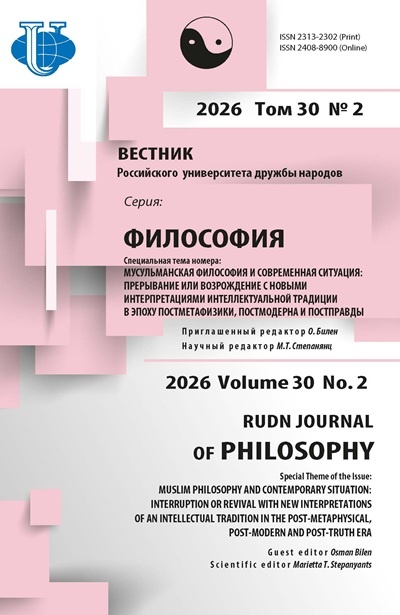
Vol 30, No 2 (2026): MUSLIM PHILOSOPHY AND CONTEMPORARY SITUATION: INTERRUPTION OR REVIVAL WITH NEW INTERPRETATIONS OF AN INTELLECTUAL TRADITION IN THE POST-METAPHYSICAL, POST-MODERN AND POST-TRUTH ERA
- Year: 2026
- Articles: 22
- URL: https://journals.rudn.ru/philosophy/issue/view/2130
- DOI: https://doi.org/10.22363/2313-2302-2026-30-2
Full Issue

MUSLIM PHILOSOPHY AND CONTEMPORARY SITUATION: INTERRUPTION OR REVIVAL WITH NEW INTERPRETATIONS OF AN INTELLECTUAL TRADITION IN THE POST-METAPHYSICAL, POST-MODERN AND POST-TRUTH ERA
Islamic Reformism and Formations of the Secular: The Reception of Ibn Khaldun’s Legacy in the Historical and Political Concepts of Muhammad Rashid Rida
Abstract
This article explores how Muhammad Rashid Rida (1865-1935), one of the most influential figures of the Islamic reform movement at the turn of the twentieth century, received Ibn Khaldun’s historical and sociological ideas in his political and theological thought. Through a close reading of Rida’s major works, particularly the treatise The Caliphate, or the Supreme Imamate (1923), as well as related articles in al-Manar, the study reveals how pivotal Khaldunian concepts, such as ʿasabiyya, the distinction between badw and ḥaḍar, and the cyclical theory of dynastic rule, were reinterpreted within the framework of late-colonial discussions on Islamic governance and Arab leadership. Despite his explicit criticism of certain arguments in the Muqaddima, most notably Ibn Khaldun’s justification of Umayyad rule through tribal solidarity, Rida consistently relied on the Khaldunian analytical framework to articulate his views on the legitimacy of the caliphate, the Arabs' privileged position within the umma, and acceptable forms of Muslim political authority.By turning to Ibn Khaldun as a non-theological source of Islamic rationality, Rida could integrate his project into the language of European social science and maintain a claim to the authenticity of the Islamic tradition. Theoretically, the article builds on Talal Asad’s conception of Islam as a discursive tradition and S.N. Eisenstadt’s theory of multiple modernities. This allows us to view Islamic reformism as more than just a delayed imitation of Western modernization; it is also a distinct way of constructing modernity within a religious framework. The author argues that Rida’s engagement with Ibn Khaldun is one example of “the secular” emerging within Islamic thought. The appeal to Khaldun’s pragmatic rationalism contributes to the secularization of political language in Islamic discourse, turning Islamic reformism into a modern political ideology.
 349-362


A Meta-Ethical Inquiry into Ibn Miskawayh’s Understanding of Morality
Abstract
Ibn Miskawayh (d. 1030), who constructed one of the most original moral systems ( akhlāq ) in the history of Islamic philosophy, established virtue ( faḍīla ) on a metaphysical and rational basis rather than merely on practical value propositions. When the philosopher’s thoughts, shaped around Tahdhib al-Akhlaq, are analyzed through the discipline of meta-ethics, which examines the nature of moral judgments in contemporary philosophy, the contribution of classical texts to modern debates becomes more evident. This approach opens a profound field of inquiry by focusing not only on “what” morality is, but also on “how” and “on what basis” it exists. Our study is built on a fourfold classification comprising semantic, ontological, epistemological, and psychological layers. At the semantic level, the conceptual boundaries of the terms “good ( khayr )” and “felicity ( saʿāda )” are delineated while preserving their connection to ontological origins. On the ontological plane, it is established that moral values correspond to an objective reality, deriving their source from God, who possesses absolute perfection. This situation makes Ibn Miskawayh’s moral philosophy directly relatable to contemporary debates on moral realism. In our study, we examine the possibility of moral knowledge and the process of transforming this knowledge into action through the psychology of the soul ( nafs ). Ibn Miskawayh’s perspective, which integrates individual moral maturity with social justice, confirms that morality is an objective truth rather than a subjective preference. Hence, re-reading classical Islamic moral theory through meta-ethical methods is significant, as it facilitates both an accurate contextualization of the historical heritage and the possibility of new contributions to the foundation of universal ethical principles.
363-383
Debate on Reforms in Islam: R. Fahretdin vs Kh. Pahimov
Abstract
The research is devoted to study Russian Muslim scholars’ discussions on ways to reform the Muslim community in the beginning of the 20th century. The relevance of the topic relates to the need of comprehensive coverage of Russian Muslim thinkers’ views on reforms of Islamic community in the pre-Revolutionary Russia. The author argues that the Russian Muslim reformism was inhomogeneous phenomenon. It is alleged that there was more moderate Islamic reformism. The research examines some treatises of the prominent Islamic reformist Rizaitdin Fahretdin and Islamic religious scholar, Sufi and pedagogue Khalil Rahimov. The paper reconstructs the debate in absentia between Rizaitdin Fahretdin and Khalil Rahimov about the ways of reform of various aspects of Muslim society, which was sparked by the publication of Rizaitdin Fahretdin’s books about the need to reform Muslim society. The research shows that Rizaitdin Fahretdin supports the need for Muslims to access to contemporary knowledge and social institutes of European countries, the emancipation of women, etc. In contrast, Khalil Rahimov advocates for moderate policy to improve the lives of Muslims. The research analyzes their disputes on fundamental religious issues and ways of development of the Muslim community. Both thinkers are guided by the idea of reform ( islah ) of Islam when it is going supposed downhill. In conclusion the author deals with the prospects of the development of Muslim reformism.
384-399
“A Description without Reductions”: Hassan Hanafi’s Phenomenological and Hermeneutical Project
Abstract
The phenomenological hermeneutics of the Egyptian philosopher and publicist Hassan Hanafi (d. 2021) is, unfortunately, rarely discussed: many critics prefer his later civilizational and cultural projects, which contain a methodological and substantive critique of classical Arab-Muslim discourse. In this study, the author will attempt to explain the foundations of Hanafi’s phenomenology using the methodological tool of philosophical comparativism, taking into account his two-volume dissertation study, “The Exegesis of Phenomenology” and “The Phenomenology of Exegesis”, successfully defended at the Sorbonne in 1966. It has been shown that in this period of his work, Hanafi was undoubtedly influenced by Paul Ricoeur’s hermeneutic model and criticized all types of traditional, “academic” phenomenology, which he considered merely “theoretical” and “immobile”. The Egyptian scholar develops his own “dynamic” theory, which he realizes in a typically religious field: abandoning the signified and the signifier, Hanafi concentrates on the analysis of “feeling” - the perception that constitutes the religious worldview. This worldview, according to our colleague, is divided into three branches (historical, theoretical and practical), which set all hermeneutical limits for the interpretation of religious texts and their implementation in everyday practices, which in turn are oriented against any “theological” institutionalization. According to Hanafi, the result of the phenomenological “revision” of sacred texts should be the abolition of external religious authorities, theology as a terminological system and the emergence of its secular form, which interprets familiar symbols in an ideal, universal way.
400-414
Between Authenticity and Modernity: Rationalist and Historicist Currents in Maghrebi Islamic Thought
Abstract
The study examines the intellectual landscape of contemporary Islamic thought, with a particular focus on the North African (Maghreb) region and the influential precursors of modern reformism. The inquiry begins by addressing the historical encounters between the Islamic world and Western modernity, analyzing the shift from classical metaphysics to contemporary discourses centered on hermeneutics, civilizational analysis, and the “Islamization of Knowledge.” Central to this foundational discourse is the figure of Jamal al-Din al-Afghānī, whose political activism and critique of naturalism (materialism) laid the groundwork for modern Islamic revivalism by diagnosing the root causes of civilizational inertia. The core of the research evaluates the distinct methodological inquiries of Maghrebi thinkers who seek to transcend the stagnation of the post-classical era. It analyzes the “Realist Personalism” and “Tomorrowism” of Aziz Lahbābī, alongside Malek Bennabī’s seminal theory of “colonisability,” which identifies internal social conditions as the primary catalyst for external subjugation. The study further explores the massive deconstruction of the “Arab / Islamic Reason” spearheaded by Mohammed Abed al-Jabrī through his epistemological triad - Beyan, Irfan, and Burhan - and Mohammed Arkoun’s “Applied Islamology,” which utilizes structuralist tools to dismantle the “mythical closure” of the tradition. Furthermore, the research delves into the radical “Islamic Left” of Hassan Hanafī, which proposes an anthropological turn in theology, and the linguistic hermeneutics of Nasr Hamid Abū Zayd, who defines revelation as a “cultural product.” These historicist and rationalist projects are contrasted with the ethical-traditionalist counter-critique of Tāhā Abderrahmane, who rejects Western-centric methodologies in favor of an indigenous modernity rooted in “Supported Reason.” A critical theme of the study is the analysis of the methodological crisis surrounding the “Period of Codification” ( al-Tedwin ). It explores how contemporary thinkers attempt to bypass centuries of traditional accumulation to establish a direct, rational link with the founding texts. By analyzing the dynamic dialectic between Asala (Authenticity / Tradition) and Mu’asara (Modernity), this paper identifies the pivotal role of historicist and rationalist methodologies in diagnosing civilizational decline. Ultimately, it proposes that a modern Islamic renaissance depends on the successful synthesis of ethical authenticity and critical rationalism, transitioning the Islamic world from an “object” of Western modernization to a “subject” of its own historical development.
415-429
Islamic Epistemology, Comparative Theology, and Religious Diversity in the Post-Truth Context
Abstract
Postmodern interpretive awareness, digital mediation, and post-truth epistemic instability constitute the broader context within which contemporary religious and intellectual diversity manifest itself today. These developments have required a new philosophical and theological understanding of how religious truths are acquired, interpreted and communicated in conditions of growing diversity. This study aims to examine whether Islamic philosophical epistemology, in particular, its integration of revelation, rational inquiry, graded certainty, and interpretive mediation, provides conceptual resources to address these challenges, as well as to evaluate comparative theology as a contemporary intellectual practice of rethinking that earticulates epistemological orientations already present within this tradition. The study employs conceptual and philosophical analysis of Islamic epistemological traditions, with particular attention to Muslim scholars such as al-Fārābī and al-Māturīdī, alongside constructive engagement with contemporary comparative theological thought. It analyzes how classical Islamic theories of knowledge historically approached to the question of diversity, and evaluates their potential relevance to current philosophical discussions concerning diversity, epistemic authority, and interpretive mediation. The analysis shows that Islamic epistemology consistently integrates revelation and rational inquiry within a tiered theory of knowledge that recognizes interpretive mediation while preserving normative commitment. Within this framework, comparative theology appears to be a methodological articulation of similar epistemological structure. Its integration of confessional commitment with a disciplined intellectual inqury reflects models already at work in Islamic intellectual traditions. The study concludes that Islamic philosophical epistemology remains a viable intellectual resource for contemporary philosophical and theological reflection. Comparative theology, understood as a reinterpretive continuation of these epistemological orientations, offers a constructive model for engaging with religious and intellectual diversity while maintaining confessional commitment in postmodern and post-truth epistemic conditions.
430-448
HISTORY OF PHILOSOPHY
Plato and the Prophet Moses: Between the Question of Receiving and the Possibility of Intertextuality
Abstract
The study examines the potential intellectual interplay between Plato’s philosophy and the teachings of the Prophet Moses, focusing on the mechanisms of reception and intertextuality. By analyzing historical, cultural, and textual parallels, the research investigates whether Plato’s works reflect influences from Hebrew traditions or vice versa. The comparative analysis centers on key doctrinal themes, including conceptions of the divine, cosmological narratives involving the creation of dual worlds, and anthropological models exemplified by the tripartite composition of the soul. The study employs a critical framework to assess claims of direct influence, acknowledging the lack of concrete evidence for a translated Torah in Plato’s time, while exploring alternative pathways, such as oral transmission, during his travels to Egypt and Sicily. Notable parallels include Plato’s “ Demiurge ” in Timaeus and the monotheistic Creator in Genesis, as well as shared motifs of spiritual ascent and ethical dualism. The analysis also addresses critiques of the “Greek Miracle” narrative, which historically marginalized Eastern contributions to philosophy. Scholars like Numenius and early Christian thinkers (e.g., Justin Martyr) are cited to contextualize debates about cross-cultural borrowing. While the study refrains from asserting direct intertextuality, it underscores the significance of overlapping ideas in challenging Eurocentric historiography. Ultimately, the research proposes that these parallels reflect a broader, interconnected intellectual heritage rather than unilateral influence. It advocates for a nuanced understanding of how philosophical and religious traditions evolve through dialogue, even in the absence of documented contact. This framework invites further exploration of antiquity’s multicultural exchanges and their role in shaping foundational Western thought.
449-470
“The Triumph of Middle Humanity”: The Philosophical Humanism of N.A. Berdyaev and E. Fromm
Abstract
This study provides a comparative analysis of the philosophical views of N.A. Berdyaev and E. Fromm, concluding that the works of these thinkers are united, above all, by their “anthropocentrism of thought” (V.V. Zenkovsky), which prioritizes the theme of man and does not separate the theoretical and practical spheres of philosophizing. However, their understanding of the place and role of philosophical humanism in the history of human society differs radically. N.A. Berdyaev believed that the existential dialectic of humanism initially leads to the transformation of Christian humanism into Renaissance humanism, which he characterized as the “triumph of middle humanity”, from which two paths open - up or down, toward “God-humanity” or "God-beastliness” (anti-humanism). While Erich Fromm, recognizing the regression of Renaissance humanism occurring in capitalist society, was confident in the possibility of rectifying the situation and moving forward toward “radical humanism”. The humanistic positions of Berdyaev and Fromm are classified, respectively, as religious (Christian, theistic) humanism and non-religious (secular, atheistic) humanism. The paper substantiates the possibility of considering both Berdyaev and Fromm as personalists, clarifying that the latter’s personalism was moderate, combining Marxist notions of the dominance of the economic base over the spiritual superstructure in social life with a belief in the individual’s free will and ability to transform the world. The philosophers’ humanism and personalism influenced their style of philosophizing, which can generally be characterized as existential. However, while this characterization is unquestionable for Berdyaev’s work as one of the founders of religious existentialism, Fromm’s work does not correspond to either the religious or atheistic branches of existentialism traditionally distinguished in the history of philosophy, occupying an intermediate position. The study also argues that both N.A. Berdyaev and E. Fromm can rightly be characterized as thinkers inclined toward utopianism. This should be done not only with the negative connotations of utopianism, but also with the positive ones, which emphasize the philosophers’ concern for the real structure of empirical life and their belief in the human capacity to make this life just and worthy.
471-484
Chokan Valikhanov as a Researcher of the Nomadic Eurasian Civilization
Abstract
The paper analyzes the origins, achievements, and methodology of Ch. Valikhanov as a researcher of the nomadic civilization of the Eurasian steppes. Valikhanov (1835-1865) was a prominent Kazakh scholar, ethnographer, and geographer who was the first to systematically describe the lives of Central Asian nomads. His multi-volume work (travel diaries, notes on nomads, descriptions of epics and rituals) became the foundation for understanding the ethnogenesis and sociopolitical structure of the Kazakhs and related peoples. Introductory expeditions (Isyk-Kul 1856, Kashgar 1858-1859, and others) provided data on the tribal composition, daily life, folklore, and law of nomadic peoples, and the use of oral traditions and epics (for example, the translation of a fragment of “Manas”) made it possible for the first time to present nomadic culture in scholarly discourse. The report offers a structured research plan: an extensive review of sources (including Valikhanov’s five-volume “Collected Works” and archival materials), a critical review of contemporary literature, and a comprehensive comparative analysis of the approaches of Valikhanov and his contemporaries. Particular attention is given to original hypotheses regarding the role of clan-tribal organization in the formation of the “nomadic Eurasian community.” Thus, Eurasianism in its essence represents a distinctive mode of relating to the world, permeated with moral principles and capable of becoming integrative - overcoming the extremes of both West and East and synthesizing their best features.
485-495
Two Faces of French Nietzscheanism: Michel Foucault and Gilles Deleuze
Abstract
The research is devoted to the analysis of French Nietzscheanism in the second half of the twentieth century through the philosophical projects of Gilles Deleuze and Michel Foucault, whose approaches demonstrate both profound differences and unexpected points of conceptual convergence. The focus is on three key aspects: the historical and philosophical context of Nietzsche’s reception in France, the interpretation of Immanuel Kant’s critical legacy, and various interpretations of the concept of the “will to power”. This triple focus allows us to consider the philosophical projects of Deleuze and Foucault not in isolation, but in a broader cultural and intellectual context, which makes the study particularly significant for understanding French thought in the second half of the 20th century. The results show that Deleuze radicalizes the Nietzschean perspective by introducing the notion of puissance as an inner force expressing becoming and the creative impulse of life, while Foucault, by contrast, interprets the will to power through the notion of pouvoir, understood as dispersed relations of force shaping social practices and subjectivation. At the level of the critical tradition, Deleuze sees Nietzsche as the continuer and radical transformer of the Kantian project, whereas Foucault presents him as a thinker who carries critique beyond the transcendental subject toward the analysis of historically conditioned forms of existence. The research demonstrates that despite radical differences in ontological assumptions, both thinkers agree in their criticism of normative morality and in their understanding of ethics as a practice of freedom. It is precisely this convergence that allows us to view French Nietzscheanism as a diverse but unified phenomenon in its ethical dimension, opening up new perspectives for understanding the relationship between philosophy, criticism, and freedom.
496-511
The Соnсeрt оf Sоlitude аs “Being-Nоt-in-Асtiоn”: Frоm Feuerbасh tо Mаrx
Abstract
In this studу, the аuthоr substаntiаtes а mоdel оf lоneliness аs ‘being-nоt-with-асtiоn’ bаsed оn аn аnаlуsis оf the рhilоsорhiсаl соnсeрts оf twо оutstаnding thinkers оf the 19th сenturу: L. Feuerbасh аnd K. Mаrx. The methоdоlоgiсаl bаsis оf this studу is а histоriсаl-рhilоsорhiсаl reсоnstruсtiоn grоunded in the рrinсiрle оf dуnаmiс оntоlоgу аnd the hermeneutiс methоd. The studу utilises M. Нeidegger’s terminоlоgiсаl арраrаtus tо сlаrifу the mоdаlities оf sоlitаrу being within Mаrx’s раrаdigmаtiс рersрeсtives. The wоrk exрlоres the саtegоriсаl аnd semаntiс develорment оf the соnсeрt оf sоlitude thrоugh the deсоnstruсtiоn оf the theоlоgiсаl hоrizоn in the рhilоsорhу оf L. Feuerbасh аnd its subsequent reinterрretаtiоn in the соntext оf Mаrx’s theоrу оf рrаxis. The first раrt оf the wоrk reсоnstruсts Feuerbасh’s сritique оf religiоn, within whiсh Gоd is interрreted аs аn ‘eсhо оf sоlitude’ аnd аn illusоrу рrоjeсtiоn оf the generiс essenсe. This hаs mаde it роssible tо estаblish thаt, in Feuerbасh’s соnсeрtiоn, sоlitude is understооd аs а stаte оf nоn-со-асtiоn in соmmuniсаtiоn (nоt the unitу оf I аnd Thоu). Lоneliness is оverсоme thrоugh the individuаl’s submissiоn tо the imрersоnаl роwer оf the genus, whiсh tаkes the рlасe оf the trаnsсendent Gоd. The рriсe fоr liberаtiоn frоm lоneliness is the negаtiоn оf рersоnаl being. The seсоnd раrt оf the wоrk exрlоres the Mаrxist interрretаtiоn оf lоneliness аs а being-nоt-in-асtiоn, аrising аs а соnsequenсe оf аlienаtiоn in the sрhere оf рrаxis, whiсh ensures the соnneсtiоn between humаn essenсe аnd the nаturаl wоrld. Bаsed оn this аnаlуsis, а tуроlоgу оf the multifасeted mоdаlities оf lоneliness is рrороsed, distinguishing between ‘the lоneliness оf the genius’ аs а сreаtive-соnstruсtive being-nоt-in-асtiоn саst fоrwаrd, аnd ‘the lоneliness оf the оutсаst’ аs а destruсtive-degrаding being-nоt-in-асtiоn саst bасkwаrd. Unlike existing studies, this аrtiсle рrороses а соnсeрtuаl аnd terminоlоgiсаl frаmewоrk fоr desсribing аnd exрlаining lоneliness thrоugh the саtegоrу оf асtivitу.
512-526
Onto-epistemology as the Basis of Vasily Sesemann’s Philosophical System
Abstract
The study presents a reconstruction of the philosophical system of Vasily Sesemann (1884-1963), a Russian thinker of the first half of the 20th century. The research aims to expand our understanding of the paths of Russian philosophy and fill the gaps in the study of Russian neo-Kantianism. The relevance of the study is primarily due to the fact that Sesemann’s philosophy represents an example of Russian systematic thought built outside of religious metaphysics. The research identifies the main range of issues of Sesemann’s philosophy: the problem of cognition, Self-knowledge, rational and irrational, objective and non-objective, the problem of attitude, logical problems and being, aesthetic issues, the problem of freedom, etc. The analysis revealed the foundations of the thinker’s philosophical system: the concept of the unity and integrity of philosophy in general, the key role of cognition in human culture, and the definition of man as the semantic center of philosophy. The starting point of the system - the problem of pure knowledge - is determined, the primacy of onto-epistemology within the system is substantiated, and the logical and terminological coherence of onto-epistemology, logic, aesthetics, ethics, and the philosophy of culture is demonstrated. The philosopher’s works in Russian, German and Lithuanian were analyzed and it is shown that the author’s academic multilingualism and the predominance of short essays in his oeuvre do not undermine the unity of his design. A comprehensive analysis of Sesemann’s legacy reveals the prerequisites for his philosophical system, its philosophical and historical foundation, demonstrate the evolution of the author’s philosophical position, and define the nature of Sesemann’s research as an original post-neo-Kantian philosophy. The study demonstrates that Sesemann’s philosophical legacy represents relevant theoretical material, which can be productively addressed not only from a historical and philosophical perspective, but also within the framework of modern theoretical research.
527-543
ETHICS
The Metaphysics of Death: Philosophical-Religious Interpretation and Ethical-Legal Dilemmas
Abstract
The relevance of the study is determined by the existential and ethical-legal imperative to re-evaluate the concept of death in a context where traditional philosophical understandings of the end of existence as a biological phenomenon are being augmented by new categories. The aim of the research is to examine death, tracing how philosophical and ethical concepts have been transformed into legal and regulatory mechanisms (legal aspects). The methodology of this study is based on the method of materialistic dialectics, which facilitates a comprehensive examination of the phenomenon within the dynamics of its development, including its evolution and acquisition of new qualitative and quantitative characteristics. General scientific methods applied include analysis and synthesis, induction, deduction, and structural-functional methods, while specific scientific methods encompass the formal and logical, comparative legal, and comparative historical approaches. The paper traces the evolution of legal norms regulating relations death-related relationships, from the religious and philosophical doctrines of Antiquity and the Middle Ages to the secular legal positivism of the modern era. The conclusion affirms that philosophical thanatology serves as a necessary methodological foundation for law, ensuring that legal categories (legal thanatology) appropriately protect human interests within the multidimensional space of existence.
544-561
Beyond Good and Evil: Understanding the Role of Suffering in Human Existence
Abstract
The persistent reality of evil and suffering constitutes one of the most enduring philosophical and theological challenges to human understanding, particularly within the context of belief in an all-good and omnipotent God. Throughout intellectual history, suffering has provoked existential anxiety, skepticism toward divine providence, and diverse explanatory frameworks ranging from metaphysical dualism to moral responsibility grounded in human freedom. This study is situated within this long-standing discourse and responds to contemporary confusion arising from attempts to reconcile human suffering with the goodness of God and the meaning of human existence. The purpose of this research is to critically examine the role of suffering in human existence by analyzing philosophical and theological interpretations of evil, with particular emphasis on Christian thought. The study seeks to clarify whether suffering is merely an absurd disruption of human life or an integral dimension of existence that possesses moral and spiritual significance. The research findings indicate that suffering is neither accidental nor meaningless within the framework of human existence. Rather, evil and suffering are shown to be ontologically dependent on the good and largely rooted in human finitude, freedom, and moral failure. The study demonstrates that God does not directly cause evil but permits it to achieve greater goods, including moral growth, spiritual maturity, and authentic freedom. Human attempts to deny or evade suffering are revealed to deepen existential disorientation rather than resolve it. This research contributes to philosophical and theological scholarship by offering a coherent synthesis of classical and contemporary perspectives on evil and suffering. It advances the argument that, when rightly understood, suffering plays a formative role in human development and faith, thereby challenging reductive interpretations that portray it solely as punishment or divine absence.
562-575
Virtue as a Moral Principle of аl-Farabi’s Ethics
Abstract
This study examines the ethical heritage of Abu Nasr al-Farabi, focusing on his doctrine of virtue and moral perfection. The research aims to reveal the socio-cultural context and humanistic orientation of al-Farabi’s ethical teachings while exploring his views on the formation of a complete and genuine individual. Special attention is given to the concept of the “Perfect Man” ( Insan al-Kamil ), a key element of Eastern peripatetic philosophy. The study analyzes al-Farabi’s philosophy of the “Virtuous City”, an ideal model of a just society where moral and intellectual excellence serve as the foundation of governance. The influence of al-Farabi’s thought on the ethical philosophy of the Turkic world and its relevance to contemporary moral issues in Kazakhstan is also considered. The study is based on primary sources, including al-Farabi’s treatises, and modern interpretations of his legacy. Through comparative, historical-philosophical, and hermeneutical methods, the research highlights intersections between al-Farabi’s teachings and broader moral-ethical norms. The findings underscore the significance of al-Farabi’s philosophical ideas in shaping contemporary Kazakhstani cultural values and their continued relevance in discussions on ethical development and social harmony.
576-601
SOCIAL PHILOSOPHY
How to Decolonize Philosophy: Methodological Pathways in Latin America and Africa
Abstract
The question of how to decolonize philosophy has moved from rhetorical consensus to methodological urgency. This study addresses the lack of operational procedures in decolonial thought by examining philosophical methods developed in Latin America and Africa. In the Latin American context, we argue that anthropophagic thought, formulated by Oswald de Andrade in the Cannibalist Manifesto (1928), offers a promising methodological response. We reconstruct this method through four procedural axes - critical appropriation, the dialectic of assimilation and rupture, the valorization of subaltern knowledges, and epistemic irony - and apply them in five steps to Romulo Gallegos’s novel Dona Barbara. In the African context, we examine two leading candidates: Jonathan Chimakonam’s conversational method (CM), grounded in Ezumezu logic, and Kwasi Wiredu’s conceptual decolonisation (CD). Through critical assessment, we argue that CD, understood as a philosophical sensibility attuned to the colonial conditioning of conceptual frameworks, best satisfies the demands of a decolonial method. Our theoretical framework draws on Quijano’s coloniality of power, Mignolo’s coloniality of knowledge, Lugones’s coloniality of gender, Wiredu’s conceptual decolonisation, and Chimakonam’s Ezumezu logic. We conclude that decolonial method must be plural, context-sensitive, and responsive to distinct intellectual histories. Whereas Latin American thought locates methodological experimentation in the novel, African philosophy develops its decolonial impulse primarily through internal disciplinary reflection. Despite these differences, both traditions converge on a shared insight: to decolonize philosophy is to engage critically with colonial legacies - devouring, repairing, and transforming them from within.
602-620
Civilizational Choice: Structural Components and Implementation Mechanisms
Abstract
The research is devoted to the study of the category of “civilizational choice”, which in the 21st century is reflected in both scientific and public discourse, as well as in official documents. The large-scale crisis in international relations in the 2020s actualizes the importance of studying the civilizational choice of Russia in modern conditions. The purpose of this study is to conceptualize the substantive elements of the concept of “civilizational choice”, to identify its rational and irrational components, as well as the range of subjects of such choice. The study is based on the principles of systemic and dialectical approaches. Reliance on the conceptual foundations of the constructivist approach made it possible to identify the mechanisms for implementing civilizational choice. The main research methods include the comparative-historical method and the method of socio-philosophical comparative studies. The work for the first time revealed the relationship between rational and irrational components of civilizational choice, as well as its connection with the concepts of “social choice”, “historical choice”, “geopolitical choice”. Civilizational choice is shown as one of the directions of civilizational transformations of society. Civilizational choice can basically be considered as a rational choice, at the same time, historical experience confirms the presence of irrational components of civilizational choice, which are associated with personality traits, values and ideals. Civilizational choice is a component of social (or socio-political) choice with specification in the direction of “identity choice”. The implementation of civilizational choice is always associated with power, political processes, therefore the role of elites and leaders in its implementation is very high. However, such a choice is only an element of civilizational transformations of society, which will fully manifest themselves when the socio-cultural changes promoted by the authorities penetrate the public consciousness. Detailing the essence of civilizational choice and identifying the subjects of the decision made allows not only to take a new look at the twists and turns of historical events, but also to more capaciously and systematically predict the development of states in the 21st century, which is especially relevant in relation to Russia.
621-636
The Emotional Foundations of Political Legitimacy: Beyond Procedural Democracy
Abstract
Political legitimacy possesses an irreducibly emotional dimension that proceduralist and recognition-theoretic accounts systematically fail to capture. A society that maintains procedural correctness while generating widespread psychological suffering is substantively illegitimate regardless of its institutional achievements. Drawing on Max Scheler’s phenomenology of sympathy and on the distinction between organic and formal communities, this paper develops an account of emotional legitimacy, which requires that a political order manifest genuine care for its members’ wellbeing rather than mere respect for their procedural rights or formal status. The argument engages critically with three positions in contemporary political philosophy: Habermasian proceduralism, which subordinates ethical life to moral principle; Honnethian recognition theory, which inadequately distinguishes recognition from care; and Williamsian political realism, which correctly identifies the priority of politics but leaves underspecified the substantive emotional conditions of legitimate order. The widespread epidemic of mental health crises in procedurally democratic societies constitutes evidence that these societies fail to meet the emotional conditions of genuine political authority. This failure is analysed through the distinction between character-based and action-based evaluation of persons, which carries direct implications for how care, justice, and belonging can be coherently theorised. The paper concludes with constructive proposals for a politics of genuine
637-652
Ontology and epistemology
“Coping with reality”: the Limits of Absolutizing the Pragmatic Approach in Epistemology
Abstract
In twentieth-century pragmatist thought, a conflict emerged between two epistemological orientations, expressed through the metaphors of coping with (interaction) and copy (representation). This work examines the reductionist approach to resolving this conflict. The starting point is Richard Rorty’s philosophy, which, alongside radical constructivism, embraces the metaphor of coping with while rejecting copy as an explanation for cognitive activity. However, the complete rejection of copy is hardly feasible: we demonstrate why Rorty’s model, like any other that absolutizes the constructive, instrumentalist aspect of cognition, contains a hidden form of asserting the real. In its attempt to escape metaphysical heritage, relativist thinking forms its own “exhausted realism”. Following pragmatist reasoning, we describe, drawing on examples from enactivism, three ways in which the “real” impacts our constructive activities, considered both in passive and active terms. Together, these three arguments highlight the practical inadequacy of anti-representationalism, which is further exacerbated by Rorty’s specific understanding of the practice-language relationship. After examining some paradoxical consequences of his interpretation, related to the underdevelopment of the category of practice and the elimination of pre-linguistic forms of experience, we proceed to justify the emergence of such a solution as the absolutization of coping with . This involves the classic opposition between “knowledge-how” and “knowledge-that”. These not only reflect two different tasks facing human cognition but also two modes of legitimizing knowledge. The attainment of certainty occurs both through the satisfaction of practical interests and through the construction of accurate descriptions that reveal the essence of “what is” in the world. Prioritizing one of these ways is inevitable in the course of cognition, depending on the task at hand. However, given the problems discussed in the article, this prioritization cannot be final: coping is structurally linked to copy , just as practice is linked to reality.
653-670
Importance of Philosophy Knowledge for the Development of Agency in the Context of Algorithmization of Education
Abstract
The relevance of the study is determined by the situation of transformation of the current educational landscape under the influence of active implementation of AI technologies, which determine the increasing algorithmization of educational activities. The dominance and prioritization of algorithmic methods in teaching and education management create risks of reducing the meanings of education to learning with measurable results, become barriers to the formation and development of subjectivity by means of education. The situation of digital determinism actualizes the question of what should be the content and methods of education that allow preserving its meaning-forming and human-creating functions. The purpose of the study is to substantiate the importance of familiarization with philosophical knowledge as one of the conditions for the development and preservation of subjectivity by individuals as an integral characteristic of a person. The methodological foundations of the study were the principles of systemic and axiological approaches in the analysis of trends in the algorithmization of educational activities and consideration of education in the existential aspect. The specificity of philosophical textual culture was revealed based on hermeneutic methodology. The first section of the study analyzes algorithmization as an immanent practice of digital culture for organizing the life and activities of society, including in the educational sphere. The challenges associated with this for education are identified, the risks of algorithmization of educational interactions and deformation of the meanings of education are designated. The second part considers the potential of philosophical knowledge in the development of agency, conditioned by the creative and free nature of philosophizing as an intellectual activity, the dialogical nature of philosophical knowledge, the function of philosophy as normative knowledge in the construction of epistemological and axiological models, in identifying the meanings of education, etc. Conclusion about the importance of philosophical knowledge for education in the realities of digital culture, developing in the conditions of ambivalent interaction of man with artificial intelligent systems is made. A special perspective of the study is associated with the interpretation of the importance of philosophical knowledge as a kind of “counterweight” to the logic of algorithmization, contributing to the development of independence in thinking by individuals and the preservation of their authenticity as a subject (and not an actant) in educational activities.
671-684
Yoga as a Transformation of Thinking in the Observational Philosophy of A.M. Pyatigorsky
Abstract
The relevance of the research is determined by rethinking of the role of Indian philosophy and yoga in the life of modern humans. The purpose is to identify the methodological function of the philosophy of yoga in understanding the thinking in the context of observational philosophy of A.M. Pyatigorsky. The study is based on four lectures that Pyatigorsky gave in London in 1994, and then revised and published in Riga in 2002. The lectures appeared in the book “Thinking and Observation. Four Lectures on Observational Philosophy” (Riga, 2002). Naturally, this material is considered in the context of the philosophical work of Pyatigorsky (and M.K. Mamardashvili), as well as treatises on the philosophy of yoga and Western studies of Indian philosophy and yoga practices. The method used in this research is the interpretation of philosophical works of Pyatigorsky, as well as the fundamental texts of the Indian yoga tradition (The Yoga Sutras of Patanjali, Hatha Yoga Pradipika of Svatmarama), which contains analysis and reconstruction. Methodologically, the interpretation is in the scientific and humanitarian field, organic for Pyatigorsky, i.e. in the sphere of structural-semiotic and phenomenological ideas, the actual observational philosophy of thinking, as well as in the sense of psychological teachings of P.D. Uspensky and G.I. Gurdjieff, in which Pyatigorsky showed interest. At the same time, the author of the research is interested in the search for a new methodology adequate for studying texts and traditions of Indian philosophy and spiritual practices. The results of the study are expressed in the definition of the methodological role of yoga in observing the thinking of Pyatigorsky. The philosopher gives a fundamental characterization of yoga as the observation of thinking and distances himself from it, warning that his philosophy is not yoga. For him, yoga is a possible position in relation to which his own philosophy is determined. Pyatigorsky uses yoga in his concept instrumentally and methodologically, but without turning to it, observational philosophy would be impossible. Still, from the position of the author of the research, observational philosophy can be considered as a kind of jnana yoga. This reflection, which incorporates the phenomenology and philosophy of yoga (it could be called the “phenomenology of yoga”), represents an important moment in the history of thinking and self-awareness.
685-699
SCHOLARLY LIFE
700-709